HailBytes SAT vs KnowBe4 vs Proofpoint: Phishing Simulation Platforms Compared
December 11, 2025 • 11 min read

Watch: Phishing Simulation Maturity - Building a Measurement Framework (6 min)
Updated 3 September 2026. The 8-vCore floor this post was revised for has itself been retired. As of 27 August 2026 the 2 vCore Pilot and 4 vCore Departmental plans are purchasable again, so the ladder starts at 2 vCPU, not 8. Every crossover below has been recomputed against the rung that actually serves the headcount: against KnowBe4’s ~$18/user basic tier it is now roughly 343 employees at list or 273 on a one-year commitment, not 1,120 and 840. Crossovers remain stated all-in, including the cloud infrastructure you pay for yourself.
If you search for phishing simulation platforms, you’ll find two categories: enterprise SaaS products (KnowBe4, Proofpoint, Cofense) that cost $4–$30 per user per year depending on vendor and tier, usually on multi-year contracts, and self-hosted open-source tools that cost nothing in licence but require significant infrastructure work. HailBytes SAT occupies a third position: the open-source engine with the infrastructure problem solved, priced per instance rather than per seat. That makes the bill flat as headcount grows, and comparatively expensive if headcount is small.
This comparison is written from the perspective of a security team evaluating tools for an organization of a few hundred to 10,000 employees, which is the range where per-instance pricing beats per-seat pricing. We’re comparing what matters for that buyer: actual campaign capabilities, deployment effort, ongoing cost, and the quality of data you get back.
Template Libraries and Customization
KnowBe4 leads on volume: over 6,000 pre-built phishing templates, localized into 30+ languages, with new templates added monthly based on current threat intelligence. You pick a template, personalize it with merge fields, and launch. For organizations that want a library they can browse rather than build, this is KnowBe4’s strongest advantage. The limitation: templates are KnowBe4’s intellectual property. You can customize the text, but you can’t export the underlying HTML or use it outside their platform.
Proofpoint offers a smaller but curated library focused on enterprise scenarios: BEC attacks, executive impersonation, supply chain compromise pretexts. Templates are tied to Proofpoint’s threat intelligence from their email gateway product, so the simulations reflect actual attack patterns they’re seeing across their customer base. Less variety, but higher fidelity to real-world threats.
HailBytes SAT takes a different approach: you build your own templates. The HTML editor gives you complete control over every element - headers, body, images, tracking pixels, landing pages. There’s no pre-built library, which means more upfront work but zero restrictions on what you can simulate. Security teams running red team exercises or testing specific attack scenarios (spear-phishing a CFO with a spoofed board member email) need this level of control. Teams that just want a monthly “click the link” test may find it more work than necessary.

HailBytes SAT's Email Templates page - Generate with AI or Load Example Template bridges the gap for teams that don't want to start from scratch.
Deployment and Ongoing Infrastructure
KnowBe4 and Proofpoint are fully hosted SaaS. You log in, you launch campaigns. There’s no infrastructure to manage, no SMTP to configure, no servers to patch. This is the right choice for organizations that don’t have a security engineer who can administer tooling. The tradeoff is that your data lives on their infrastructure, email deliverability depends on their shared sending reputation, and you’re locked into their platform for as long as you need historical data continuity.
HailBytes SAT runs on your own AWS account. You get a pre-hardened AMI that launches in minutes, but the instance is yours - your VPC, your security groups, your data retention policies. SMTP configuration requires setup, but the documentation covers it step by step, and once configured, you’re sending from a dedicated IP that you control. This matters for deliverability: shared SaaS platforms sometimes get flagged by corporate email filters that recognize KnowBe4’s or Proofpoint’s known sending infrastructure.
Pricing and Contract Structure
KnowBe4 prices per seat per year, with tiers ranging from about $18/user for the basic plan to $30+/user for Platinum with advanced analytics. A 500-person organization pays $9,000–$15,000 annually. Contracts are typically annual or multi-year with volume discounts. The per-seat model means costs scale linearly with headcount.
A note on where these competitor numbers come from, because the arithmetic below depends on them. Neither KnowBe4 nor Proofpoint publishes list pricing, so every per-seat figure in this article is an estimate from reseller listings and buyer-reported deals rather than a vendor price sheet. Our own comparison matrix uses a higher $30–$45/seat band for KnowBe4. We deliberately run the crossover maths below at the low end of the range instead, because that is the end that favours the competitor, picking the higher figure would flatter us for free.
Proofpoint bundles security awareness with their broader email protection platform. Standalone pricing is opaque - typically requiring a sales call - but ranges from $4–$8 per user per year depending on the bundle. The advantage for existing Proofpoint email gateway customers is a unified platform; the disadvantage for everyone else is that you’re paying for integration you don’t need.
HailBytes SAT is priced per instance, not per user. A single instance handles unlimited users, unlimited campaigns, and unlimited templates; the ladder starts at 2 vCPU, and 8 vCPU, the provisioning default, is documented for up to 10,000 active learners. That is $16,800/year of software at list, or $11,760 on a one-year commitment paid upfront, plus roughly $3,360/year of cloud infrastructure billed by your own provider.
Every crossover figure below is all-in, including your own cloud infrastructure: so $20,160/year at list and $15,120/year on a one-year commitment: against the competitor’s per-seat fee alone. That is the harder comparison for us and the correct one: adding our infrastructure cost while leaving theirs out of a hosted SaaS price would be comparing two different things. Some of our older pages quoted software-only crossovers, which made us look roughly 20% better than we are; those have been retired.
| Competitor per-seat rate | Seats where HailBytes gets cheaper (at list) | On a one-year commitment |
|---|---|---|
| $25/seat/year | 806 | 605 |
| $35/seat/year | 576 | 432 |
| $45/seat/year | 448 | 336 |
| $60/seat/year | 336 | 252 |
Applied to the two vendors in this article, on the same all-in basis. Against KnowBe4’s ~$18/user basic plan an instance beats per-seat pricing above roughly 343 employees at list, or 273 on a one-year commitment; against the $30+/user Platinum tier, above roughly 206 at list or 164 committed. Below those numbers KnowBe4 is cheaper, and we would rather you knew than found out in procurement: a 500-person organization pays about $9,000 on the basic plan against $20,160 here at list or $15,120 committed. For a 2,000-person organization our annual cost is 44–66% less than KnowBe4 at list and 58–74% less on a one-year commitment, and the gap keeps widening because our bill does not move with headcount.
Against Proofpoint’s cheaper bundled $4–$8/user pricing the crossover is further out: roughly 771 employees at the $8 end and 2,760 at the $4 end at list, or 614 and 1,227 on a one-year commitment. The $4 list case is the one crossover here that lands above a rung boundary, on 4 vCPU rather than 2. At Proofpoint’s low end the instance model only pays at genuine enterprise scale, and if you are already a Proofpoint email-gateway customer getting awareness training inside the bundle, this comparison does not favour us at all. Say so to your CFO before we do.
Multi-year commitments are optional rather than required, and they are where the discount lives: 30% off the meter for one year paid upfront, 35% for two years, 40% for three, delivered as a marketplace private offer. The open-source engine means no vendor lock-in: your templates, your data, and your campaign history are portable.

Enterprise settings: MFA/TOTP, SSO/OIDC, SAML, Branding, AI, Privacy, Security - configured by you, on infrastructure you own.
Reporting and the Data That Actually Matters
All three platforms track the basics: sent, opened, clicked, submitted credentials. The differences are in what they do with that data. KnowBe4 offers a Phish-prone Percentage benchmark that compares your organization to industry averages. It’s good for executive presentations but limited for security practitioners because the benchmark methodology isn’t transparent. Proofpoint integrates simulation results with their Very Attacked People (VAP) data, correlating who clicks simulations with who receives actual malicious email. This is genuinely useful if you’re a Proofpoint email gateway customer.
HailBytes SAT gives you raw event data: every send, open, click, and submission with timestamps. There’s no benchmarking dashboard, but the data exports cleanly to CSV or connects via API to your SIEM or BI tool. For security teams that want to build their own metrics (time-to-click distribution, repeat offender tracking, department-level comparisons), raw data beats pre-built dashboards. For teams that just want a number to put in a board presentation, KnowBe4’s summary view is more convenient.
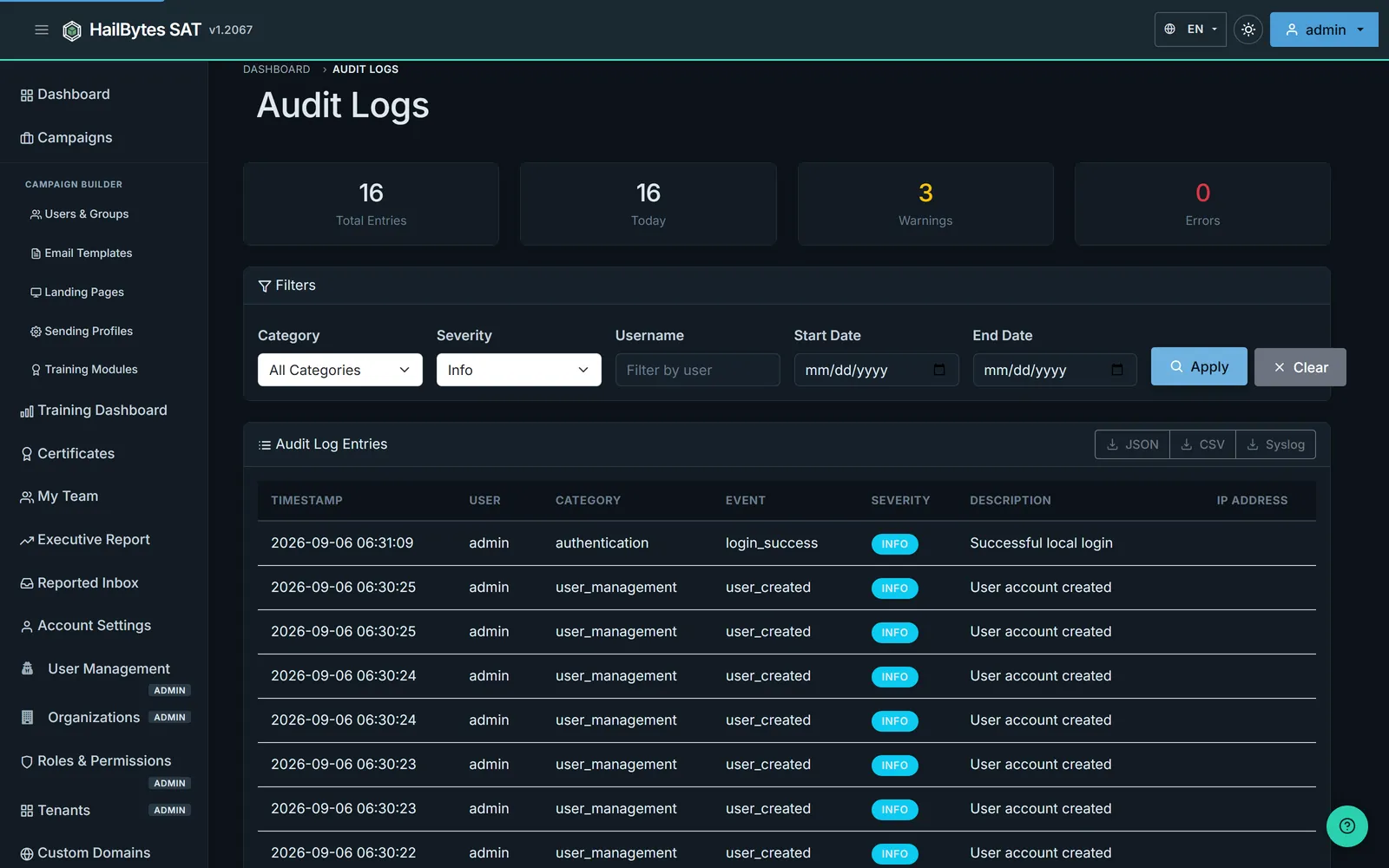
Audit Logs with JSON and CSV export, plus REST API and webhooks for Splunk, Elastic, or any BI tool. No API gating.
The honest assessment: KnowBe4 is the best choice for large organizations that want a managed experience with minimal security team involvement. Proofpoint is the best choice for existing Proofpoint customers who want integrated threat intelligence. HailBytes SAT is the best choice for security teams above roughly a thousand employees that want full control, cost that stops scaling with headcount, and the flexibility to customize every aspect of their simulation program. Below that size, per-seat pricing is usually the cheaper answer and we will say so on the call.
Try HailBytes SAT Free
Full control, no per-seat pricing, no mandatory multi-year contract, and up to 40% off the meter if you choose to commit. Launch your first phishing simulation campaign today and see the difference infrastructure ownership makes.