HailBytes ASM vs Censys ASM: Which Attack Surface Management Platform Is Right for You?
June 11, 2026 • 10 min read
Updated 3 September 2026. The 8-vCore floor this post was revised for has been retired. ASM now starts at 4 vCPU, its documented minimum, at about $11,040/year all-in at list or $8,520 on a one-year commitment, against $20,160 / $15,120 at the 8 vCPU size we recommend for production. The revised figures below are stated at 8 vCPU and are therefore conservative for a small, stable surface.
Attack surface management has split into two distinct schools of thought. The first is internet-wide passive discovery: Censys continuously scans the entire public internet and lets you query that data to find your assets. The second is active reconnaissance pipelines: HailBytes ASM deploys an orchestrated toolchain against your specific targets and produces findings your team can act on immediately.
Both approaches call themselves “ASM.” But the gap between them matters enormously for security teams evaluating platforms. This comparison covers what actually differs (discovery methodology, deployment model, MSSP multi-tenancy, pricing, and data sovereignty) so you can make an informed choice rather than buy marketing copy.
The target audience for this guide is a security team of 3–25 people, or an MSSP managing 10–200 clients. We’re not comparing enterprise Fortune 500 programs; we’re comparing what the two platforms deliver to security practitioners doing the daily work.
Discovery Methodology: Passive vs. Active
Censys ASM is built on Censys’s proprietary internet-wide scan dataset. They continuously probe the entire IPv4 space and maintain an indexed database of what they find. When you onboard a domain, the platform queries that dataset to surface assets associated with your organization. The advantage is speed: discovery reflects scanning that has already happened. The limitation is depth. Passive discovery identifies what Censys has already indexed. Assets behind rate-limiting, authenticated endpoints, or recently deployed infrastructure may lag behind or not appear until Censys’s next scan cycle.
HailBytes ASM takes an active approach: when a scan runs, 40+ security tools execute against your specific targets in a coordinated pipeline. Subfinder, Amass, and httpx discover subdomains in real time. Nmap and nuclei map open services and probe for vulnerabilities. Screenshots capture the visual state of every discovered web application. Directory fuzzing and WAF detection run against live HTTP hosts. The finding you get is current to the moment the scan ran, not indexed from a previous sweep.
For teams focused on external exposure visibility, passive discovery is convenient. For teams running continuous monitoring or pre-engagement reconnaissance where freshness matters, active scanning returns data you can trust right now.
Deployment Model: SaaS vs. Self-Hosted
Censys ASM is a fully managed SaaS platform. Your data lives on Censys infrastructure. Login, configure seed data (domains, IP ranges, ASNs), and the platform populates an asset inventory. There is nothing to deploy or maintain. For organizations with no appetite for infrastructure management, this is attractive.
The tradeoff is that you have no control over where scan data is processed or stored, no ability to customize the scan pipeline, and no path to running the toolchain on internal or non-internet-routable assets. Censys sees only what the public internet sees.
HailBytes ASM runs in your own AWS or Azure account. The pre-hardened AMI launches in under five minutes with 120+ security controls pre-applied. You own the VPC, the storage, the data. For organizations operating under data residency requirements (GDPR, FedRAMP, HIPAA, PCI DSS), this is not a preference. It is a compliance requirement. Reconnaissance data contains sensitive information about your infrastructure; knowing exactly where it lives and who can access it is a legitimate security concern.
Self-hosting does require an operator: someone who provisions the instance, monitors it, and applies updates. HailBytes ASM’s managed service option handles this for teams that want cloud deployment without the management overhead.
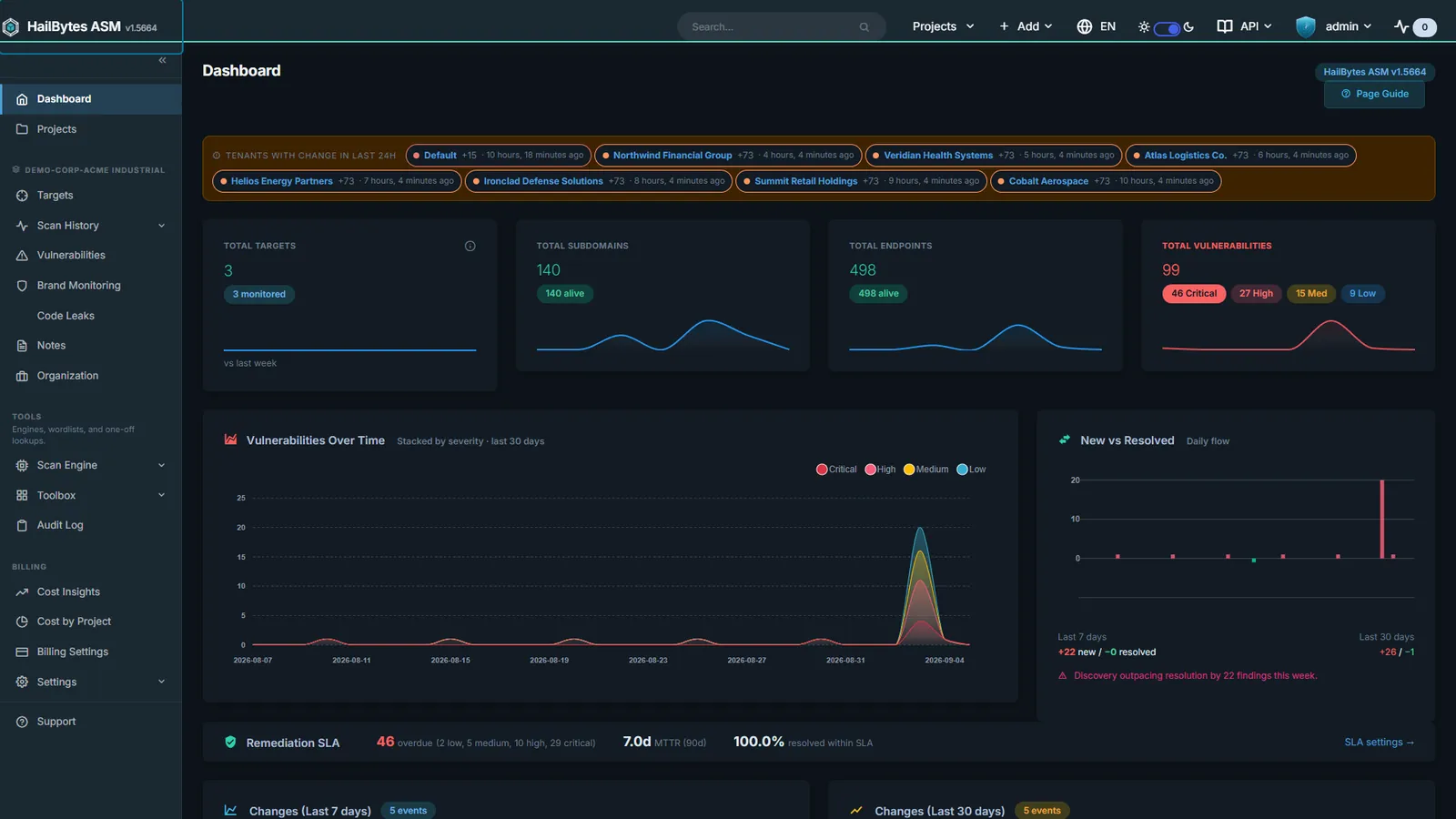
HailBytes ASM scan dashboard: live progress across 40+ tools, findings organized by severity, with scheduled monitoring and alert thresholds built in.
MSSP Multi-Tenancy: The Dividing Line
This is where the two platforms diverge most sharply.
Censys ASM is designed for a single organization. Each customer account is a separate tenant in Censys infrastructure. MSSPs managing dozens or hundreds of clients must provision a separate Censys account for each client, negotiate separate contracts, manage separate logins, and manually aggregate reporting across accounts. Censys does not offer a white-label option or a managed service portal for resellers.
HailBytes ASM is deployed by you, in your own cloud account, which changes the shape of the problem rather than eliminating it. Projects give you isolated data and scan configurations with role-based access control, the platform white-labels to your brand and your domain, and scan reports carry your company name rather than HailBytes. There is no per-client SaaS contract to negotiate and no vendor sitting between you and the client relationship.
Be clear-eyed about the limit, though, because it is the part that decides your unit economics: we recommend one HailBytes ASM instance per monitored client. Running many monitored clients off a single shared instance with recurring scheduled scans is not a supported configuration today, so the per-client platform cost is a whole instance, not a fraction of one. The white-label brand is also one brand per instance, yours, so a client that needs the portal in their own colours needs their own deployment. At the 8-vCPU size that means roughly $1,680/month all-in per monitored client at list, which does not clear a $500/month retainer. It clears a $2,000/month engagement. Price accordingly, or pass the marketplace meter through to the client so the platform line leaves your P&L entirely.
So the MSSP case is narrower than we used to claim it was. Censys still is not built for managed service delivery, no white-label, no reseller portal, a separate contract per client. But “one deployment per client” is now true of both products, so the advantage is in ownership, branding and billing path rather than in consolidating a book onto one instance. Where HailBytes wins decisively on cost is scheduled rather than continuous scanning, which the next section works through.
Pricing: Per-Asset vs. Per-Instance
Censys ASM pricing is not publicly listed and requires a sales engagement. The $15,000–$25,000 per year entry band used throughout this article is an estimate, not a vendor-published figure. It is the same benchmark our Censys comparison page carries (~$20,000+ for a small surface), and every percentage below is derived from it, so treat the percentages as approximate too. What is not in doubt is the shape: the per-asset model means costs grow as your attack surface grows, a direct financial disincentive to comprehensive discovery, and large enterprises with thousands of external assets pay correspondingly more.
HailBytes ASM runs on AWS Marketplace at $0.24/vCPU/hour. ASM starts at 4 vCPU, its documented minimum, and the size the hardening guide names as production-recommended is 8 vCPU, good for 10 to 50 scheduled scans a day. At 8 vCPU that is which is $1.92/hour, or $1,400/month of software meter at 24/7 uptime. That meter is the software fee only: deployments are bring-your-own-cloud, so add roughly $280/month for the VM, database and storage your own cloud account is billed for. There is no per-asset or per-domain pricing. Add 500 more subdomains to your scan target and the bill does not change.
Run continuously at list, that is about $20,160/year all-in, which lands inside the $15,000–$25,000 Censys band rather than below it. This is a genuine change: at the smaller instance sizes we used to sell, continuous HailBytes monitoring undercut Censys outright, and it no longer does at list. On a three-year commitment (40% off the meter, delivered as a private offer) it drops to about $13,440/year all-in, or 10–46% less than Censys.
The larger gap is in how you run it. The meter bills only while the instance is running, and most organizations scan on a schedule rather than continuously. At 50–200 running hours a month the software line is $100–$400. The infrastructure side does not scale down with it, the managed database and storage persist between scans, so hold that at the full $280/month, which puts scheduled scanning at roughly $4,500–$8,000/year all-in, or 46–81% less than Censys. An earlier revision of this article claimed 64–94% by quietly dropping the infrastructure line from the scheduled case; that was wrong and the figure above replaces it. One further caveat worth stating plainly: a term commitment is prepaid for the whole term regardless of runtime, so you take the commitment discount or the scheduled-runtime saving, not both. For the 200-employee organization with 50 external domains and 300 subdomains under management, scheduled scanning is almost always the cheaper shape. The same holds for an MSSP comparing one HailBytes instance per client against one Censys subscription per client: on scheduled runtime the HailBytes side is a fraction of the Censys band, and on continuous 24/7 monitoring at list it sits inside it.
Scan Depth and Vulnerability Detection
Censys ASM excels at asset inventory: finding domains, IPs, and certificates associated with your organization, then flagging known misconfigurations visible from the internet (expired certs, open ports, outdated software versions from banner data). It does not run authenticated vulnerability scans, directory enumeration, or application-layer probing. The platform tells you what exists and what is visibly misconfigured; it does not tell you how exploitable those assets are.
HailBytes ASM goes further down the exploitation path. After discovery, nuclei runs the Nuclei template library (9,000+ detection templates) against discovered hosts, flagging CVEs, misconfigurations, and exposure conditions that require active probing to detect. Directory fuzzing with ffuf surfaces admin panels and backup files. Dalfox runs XSS detection against discovered parameters. The output is not just “this subdomain exists” but “this subdomain is running Apache 2.4.49 with CVE-2021-41773 (RCE), here is the evidence.”
For teams using ASM output to drive a vulnerability management program rather than just maintain an inventory, this depth matters. An asset inventory without exploitability context creates prioritization work that active scanning eliminates.
SIEM Integration and Alert Routing
Both platforms offer integrations with downstream systems. Censys ASM supports Splunk, ServiceNow, Jira, and a REST API for exporting asset data. The integration model is pull-based: you query Censys for changes and ingest them.
HailBytes ASM supports push-based event dispatch to Splunk HEC, Syslog (CEF), webhook JSON, Azure Sentinel (HMAC-signed), Jira, ServiceNow, GitHub Issues, and GitLab Issues. When a new critical vulnerability is discovered, HailBytes ASM creates a Jira ticket and sends a Slack alert without waiting for a query. For SOC workflows where time-to-ticket matters, push integration over a polling model reduces mean time to remediation.
The Honest Assessment
Censys ASM is the right choice for large enterprises that want a low-friction asset inventory with no infrastructure management, have existing Censys relationships for threat intelligence data, and are not reselling services to clients. If your primary question is “what does the internet see when it looks at us,” Censys answers that question from a clean SaaS interface.
HailBytes ASM is the right choice for security teams that need active vulnerability findings (not just an inventory), MSSPs delivering continuous monitoring to multiple clients, organizations with data sovereignty requirements, and any buyer for whom the per-asset pricing model would make comprehensive coverage prohibitively expensive. It is also the only option in this comparison that is white-labelable.
The decision usually comes down to two questions. Do you need active exploitation-path findings, or just asset visibility? And do you run continuously, or on a schedule? Active findings and scheduled scanning both point to HailBytes ASM. Continuous 24/7 monitoring of a single small surface at list price is the case where Censys is genuinely competitive on cost, and you should price both.
See HailBytes ASM in Action
Active scanning, MSSP multi-tenancy, and per-instance pricing, not per asset. Launch a production-ready instance in under five minutes on AWS or Azure.